

Outside Director Small Meeting
The Board of Directors’ Role
and Ideal Form for
Enhancing Corporate Value
From left to right:
Keiko Yamaguchi
Independent Outside Director
NISSIN FOODS HOLDINGS
CO., LTD.
Masato Mizuno
Independent Outside Director
NISSIN FOODS HOLDINGS
CO., LTD.
Kumiko Shimamoto
Independent Outside Director
NISSIN FOODS HOLDINGS
CO., LTD.
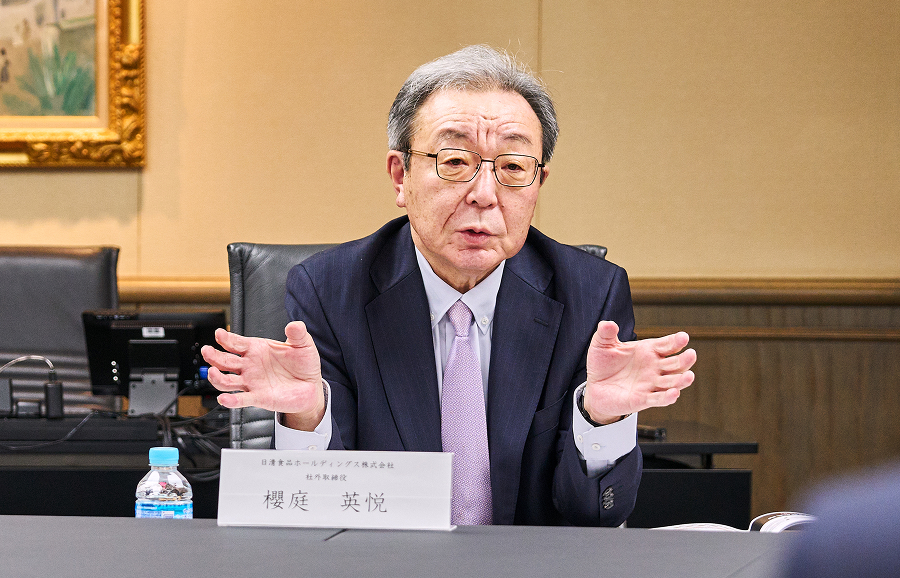
Eietsu Sakuraba
Independent Outside Director
NISSIN FOODS HOLDINGS
CO., LTD.
We regard dialogue with investors as an important initiative for achieving sustainable growth and enhancing corporate value, and we hold such opportunities on a regular basis. As part of our approach in this area, on June 11, 2026, we held a small meeting between four outside directors and institutional investors. The meeting last fiscal year took the form of a panel discussion with roughly 40 institutional investors. This time, we held meetings in two sessions of three to four investors each. This format deepened the intensity of the dialogue and encouraged highly interactive discussion across a wide range of themes. This article has been edited by organizing and integrating the dialogue from both sessions by theme.
Theme 01
Awareness of Issues and Responses in Light of a Changing Business Environment
As reflected in recent share price performance,there is concern that in recent years, your company’s corporate value has lagged expectations. There must be various reasons. What awareness of the issues have you held as outside directors, and what have you recommended to management?

MizunoWe recognize that our role as outside directors is to ensure the transparency and fairness of governance from the shareholders’ perspective and to enhance corporate value, and we repeatedly hold discussions that draw on each of our experiences and areas of expertise.
YamaguchiWe see the market capitalization decline owing to both equity market expectations and actual performance. In particular, the slowdown in the growth of the U.S. business has become an issue. At a special briefing for directors and executive officers, we presented how NISSIN FOODS Group is viewed in the equity market and conveyed the importance of planning, emphasizing that the plans and targets we announce externally are a promise to the equity market.
One reason cited for the declining market evaluation is that targets such as ROE and profit margins are not progressing as planned. What do you think are the reasons for this viewpoint?
MizunoI believe there are three factors behind why ROE and profit margins are failing to progress as planned in recent years. First, we are making capital investments on a considerable scale for future growth, but the results have yet to materialize. Of course, we understand that, for a food company, investment is not something that immediately translates into higher sales. Second, the U.S. business, which we had expected to drive growth, has fallen into a difficult situation. Third, accelerating inflation at home and abroad has pushed up costs. On top of these factors, new risks such as the situation in the Middle East have recently emerged, so we are recommending that management defer any investment that can be postponed and focus resources only where they are truly needed.
SakurabaWhen the plan was formulated on the assumption that the pandemic-driven surge in demand would continue, we outside directors agreed with the logic. I recognize that we should have taken a more cautious view. For future investments, rather than building plans on the premise that growth will keep rising, we will place importance on carefully determining what should be done and at what scale.
You revised the ROE target down from the previous 15% to 10% for the time being, and pushed back the timing for achieving 15% to 2030 or later. Personally, I see this as a very realistic target. Could you share the background behind the revision?
YamaguchiThis revision is not about ROE alone, but rather re-examines the feasibility of our medium- to long-term plan. With profits not growing as planned and the interest burden rising amid higher interest rates, a 15% ROE target is not realistic. So, we revised the target, first aiming for a recovery to 10% or more, with 15% in view beyond that. This revision does not mean weaker shareholder returns or growth investments. Our thinking is to shore up profitability while curbing cost increases, as well as to enhance corporate value by balancing growth investment and shareholder returns.

As Japan shifts from long-running deflation to an inflationary trend, the mindset of raising per-capita productivity is being tested. Could you tell us whether an inflation mindset has taken hold in management, including the specific approach to capital investment?
SakurabaAs for capital investment, with construction costs continuing to soar, we recognize that improving productivity through measures such as plant consolidation is an urgent issue. Accordingly, we are devising ways to raise productivity while holding down investment. Regarding the Kanto Plant, which is in a high-risk location and increasingly aging, we have already acquired land for a new plant, but we need to determine the appropriate scale of investment in light of current business performance.

Theme 02
Rebuilding the U.S. Market and Rethinking Global Growth Strategy
How do you analyze the background behind the U.S. business suddenly deteriorating? Please also share your assessment of the turnaround now underway.
MizunoWe see the U.S. business’s difficulties as stemming not only from sales-side issues, such as insufficient shelf space, but also from management-side issues. Rather than the previous approach of leaving overseas businesses to local personnel, we have been discussing how essential it is for people with strong management capabilities to oversee operations, while also understanding regional differences. As a result, we established the Regional Headquarters of Americas (RHQ-Americas) to oversee the Americas, and moved to a structure in which Mr. Yokoyama, former CSO, manages the North and Central America region. We are currently backing him up from Japan as we monitor progress.
YamaguchiI feel that a large part of the U.S. business’s challenges came down to a shortage of human resources. Beginning to strengthen our talent by dispatching Mr. Yokoyama and sending marketing professionals who had been successful in Japan was a major change. The addition of CHRO Hamase, who has led global HR reform at major companies, has also had a significant impact, and I see things moving in a positive direction.
SakurabaWe saw a problem in the U.S. business where sales, market analysis, marketing, and development were all operating in a disjointed way. Since the establishment of RHQ-Americas, things have been moving at a fast pace.
Regarding issues in the Americas business, last year’s panel discussion mentioned that the analysis of the current situation had been insufficient. Could you share how things have improved since then?
YamaguchiWhile we are capable of analyzing our own operations, we struggle when trying to analyze the market, particularly the competitive environment. We see this as a challenge and one cause of the gap between guidance and results. Although our capabilities are improving compared with last year, I feel issues still remain.
ShimamotoSince I introduced an analysis team from a company where I previously worked, the volume of data used for market analysis has increased dramatically and data-driven marketing is being realized. By repeatedly checking the rapidly changing consumer preferences, we intend to raise the precision of our market analysis. Going forward, the question will be how quickly NISSIN FOODS HOLDINGS can deploy overseas the marketing capabilities it has cultivated in Japan. Results are already beginning to appear in Brazil, which I find encouraging.
As food preferences change around the world, your company aims to become synonymous with the growing category of Japanese-style instant noodles. What is your assessment of this strategy?

ShimamotoIn the United States, Japanese food has taken hold, especially among younger consumers, who increasingly seek something closer to the authentic article. Riding this trend, premium Korean bag-type noodles have become more popular, and instant noodles are being reframed from a snack to a meal, creating an environment where we can compete with authentic Japanese-style ramen. A sharp rise in internet searches for “ramen near me” underscores the scale of demand, which we see as a major tailwind for our company, which offers a full lineup across instant, chilled, and frozen products.
YamaguchiWhereas past product strategy tended to be a product-driven approach that followed trends, the Japanese-style instant noodles we are now launching combine differentiation with scale, and could lead to a transformation on a global scale. I have told the Board that I want the team to secure profits through measures such as improving the profitability of unprofitable brands, and to commit fully and with resolve to launching Japanese-style instant noodles, without cutting necessary spending for the sake of short-term profit.
To enhance corporate value sustainably, growth in global markets—not just in the U.S. business—is essential. Could you share the overall direction and issues you see for the overseas business as a whole?
SakurabaWith the domestic market shrinking due to the declining birthrate, we cannot move up to the next stage unless we raise the overseas ratio from the current 40% to 50% as quickly as possible, and eventually to 60–70%. To do that, we must craft strategies rooted in the characteristics of each country.
MizunoWe are currently focused on rebuilding the U.S. business, but we have not lost sight of other regions. China, Hong Kong, and Asia are likewise generating profits under an RHQ structure, while the Middle East and Europe are improving little by little without any drastic change in approach.
YamaguchiStrengthening our overseas business requires human resource development, above all. I have told CHRO Hamase that I want her to create a mechanism for developing people who can run businesses firmly rooted overseas. Specifically, we are working backward from our “to-be” organizational vision to build and implement succession plans region by region.
Theme 03
ESG Measures and the Enhancement of Corporate Value
You are pursuing advanced initiatives such as visualizing ESG impact, but sustainability efforts are a cost-increasing factor in the short term. With burdens rising under inflation, how do you intend to link these initiatives to performance and corporate value over the medium to long term?
MizunoI see two sides to sustainability: the sustainability of the global environment and the sustainability of the business itself. On the environmental side, we are advancing various initiatives under our long-term environmental strategy, EARTH FOOD CHALLENGE 2030. On the business side, our thinking is to steadily enhance corporate value by generating stable earnings under management that takes a long-term perspective.
SakurabaAs an outside director, I have joined the Sustainability Advisory Board and report its findings to the Board of Directors. I recognize that ESG measures, even if they raise costs in the short term, will lead to cost reductions in the future. For example, the emissions trading market now becoming more popular requires reducing Scope 1 and 2 emissions and preparing data, which are steps that entail higher costs now but pay off later. In addition, in the post-SDGs era beginning in 2030, well-being is said to become a major pillar, and I expect the likelihood will rise that our KANZEN MEAL will come into full bloom.
You are advancing sustainable procurement of palm oil and other materials, but if there is a gap between your stated policy and reality, it can appear that what you say and what you do differ, risking a loss of trust from the equity market. Do you have mechanisms, such as third-party checks, to oversee these risks?
SakurabaFor palm oil, we are raising the proportion of RSPO-certified oil, a third-party certification. We have achieved nearly 100% for the domestic portion, but globally, we are still only halfway. Through discussions in certified producing regions, support for farming methods, and collaboration with oil refiners, we are aiming for 100% certified oil.
MizunoFrom the standpoint of corporate ethics as well, direct dialogue with local producers is essential. The Sustainability Committee rigorously checks matters including the consistency between what we say and what we do, but we will take your point firmly to heart.
Theme 04
Corporate Governance That Lives Up to the Trust of the Equity Market
Revisions to the Corporate Governance Code have further heightened shareholder and investor interest in Board composition and remuneration. Looking at your company, independent outside directors do not make up a majority, partly because outside directors from trading companies do not meet the independence criteria of the Tokyo Stock Exchange. To achieve management that leaves no room for criticism from the equity market, shouldn’t a majority of the Board consist of independent outside directors?
MizunoCurrently, seven of our company’s ten directors are outside directors, and five of them are independent outside directors. The international perspective and insight that directors from trading companies bring are especially valuable, and I believe the Board is highly effective. At the same time, the point that the independent ratio does not reach a majority is a challenge we should take seriously, and we will examine Board makeup thoroughly at the Management Advisory Committee, which I chair.
SakurabaLooking back at the Board’s discussions so far, remarks by directors from trading companies have often been meaningful, and in some cases they even prompted us to hold off on a resolution. From that experience, I personally recognize that there is a difference between the form of independence and a substantive contribution to corporate value. That said, the point you raise about the equity market’s view has given me a renewed awareness of the issue.
With the founding family involved in management over the long term, are the outside directors able to exercise firm checks and balances? Could you also comment on the operation of the Management Advisory Committee?
Mizuno The founding family manages with a long-term perspective, but it is the outside directors’ duty to act as a brake, checking and correcting course if things go too far. At the Management Advisory Committee, we discuss important agenda items in depth, including executive remuneration and succession plans. The discussions are led primarily by independent outside directors, and I believe we are exercising a certain degree of oversight.
Could you tell us about succession plans for the CEO and various other posts?
YamaguchiOur succession plans define the target posts and, for each post, establish a staged timing for promotion, for example, for candidates who are ready to take over immediately and those who could take over in the next term. This approach allows us to engage in more sophisticated, higher-level discussions.
MizunoWe also discuss succession plans at the Management Advisory Committee. We are strengthening talent measures under CHRO Hamase, so I expect steady improvement going forward.
The Corporate Governance Code also calls for greater effectiveness in Board operations. Could you share any operational innovations, such as the use of AI to raise the quality of discussions?
MizunoThe secretariat that runs the Board handles things with great care, but we believe that using AI can further raise the quality and efficiency of discussion, which is why we want to adopt AI proactively.
SakurabaIn fact, the Board effectiveness evaluation included a comment that materials are too detailed, and that we may not need that level of detail. By having AI, which excels at summarizing, create focused summaries that are separate from the detailed materials, we could devote more time to discussing important agenda items.
ShimamotoIn the field of corporate operations, AI use has taken hold thanks to CIO Narita, who led the way early on, making us a leading case within Japan. Such on-the-ground knowledge should feed into the use of AI in future Board meetings as well.
The equity market is also questioning the structure of your business portfolio. Some argue that, from the standpoint of business resources, you should concentrate investments on globalizing the Instant Noodles Business. Can you share your thoughts?
MizunoWe recognize that the equity market has voiced various opinions about our business portfolio. We will continue to deepen our discussions on matters such as the parent-subsidiary listing with KOIKE-YA and the significance of maintaining the Non-Instant Noodles Business, as with NISSIN YORK, including from the perspective of how to demonstrate what makes NISSIN distinctive. For the Instant Noodles Business, too, synergies with MYOJO FOODS are being questioned. Rather than simply integrating the business, we must consider the perspective of how to leverage the brand value that MYOJO FOODS has built over many years. We recognize that optimizing the portfolio, including charting a path to profitability for KANZEN MEAL, remains an issue we should continue to discuss.
Today’s meeting included many candid opinions and was highly productive. We will take back to the Board a clear outside perspective on how the NISSIN FOODS Group is viewed in the equity market and what concerns investors have, using these outside perspectives to enhance corporate value.

VALUE REPORT 2026
Introduction [693KB]
- Group Philosophy
- Social Value Creation History
- NISSIN Today
01NISSIN Value Creation [4.89MB]
- CEO Message
- Value Creation Process
- Six Capitals of NISSIN
- Our Material Issues
- COO Message
- CHRO Message
-
NISSIN Core Strengths
- ❶Branding and Marketing
- ❷Innovation
02NISSIN Growth Strategy [10.4MB]
- CSO Message
- CFO Message
- Feature: Outside Directors Small Meeting—Dialogue with Investors
- Mid- to Long-Term Growth Strategy 2030
- Growth Strategy 1 Strengthen Cash Generation
Capabilities of Existing Businesses
- Domestic Instant Noodles Business
- Domestic Non-Instant Noodles Business
-
Overseas Business
- North and Central America: United States
- South America: Brazil
- China (Incl. H.K)
- Asia/EMEA
- Messages from the RHQ Leaders
- Growth Strategy 2 EARTH FOOD CHALLENGE 2030
- Challenge to Climate Change
- Challenge to Effectively Use Resources
- Disclosures Based on TCFD and TNFD Recommendations
- Growth Strategy 3 Pursue New Businesses
- Potential of the KANZEN MEAL Brand
- Latest Topics
- Fundamental Research for Optimized Nutri-Dense Meals
03NISSIN Management Foundation [1.08MB]
- Human Capital Strategy Enhancement
- Health and Productivity Management and Human Rights Initiatives
- Corporate Governance
- Board of Directors and Audit & Supervisory Board Members
Data [491KB]
- Financial Summary
- Non-Financial Summary / Major External Evaluations
- Global Instant Noodle Market Data
- Company and Stock Information