
Sustainability Governance
Policies
EARTH FOOD CREATOR has been formulated as the Group philosophy of the NISSIN FOODS Group. To achieve this, we also formulated the NISSIN FOODS Group Sustainability Regulations in April 2020 after deliberation and approval by the Board of Directors. The regulations define the following action guidelines to realize a sustainable society and raise corporate value.
- 1.We will comply with laws, regulations, rules, conventions, and applicable international standards as well as the various regulations of the NISSIN FOODS Group and give adequate consideration to an environment and society that allows the conduct of sustainable corporate activities.
- 2.In our corporate activities, we will undertake product development with consideration for the conservation of the local and global environment—from the procurement of raw materials to production, distribution, and disposal—to seek reduction of environmental impact, and at the same time, contribute toward society’s efforts in saving energy, using less resources, and recycling.
- 3.We will prioritize the protection of people’s health and safety in the raw materials, additives, materials for containers and packaging, and other items being used in products.
- 4.We will promote initiatives for the respect of human rights with suppliers and all business partners, including the prohibition of discrimination based on nationality, ethnicity, religion, gender, age, social status, and disabilities, and the provision of safe and healthy working environments.
- 5.We will promote health and productivity management so that all employees can maintain and enhance their health and fully apply their capabilities when carrying out their work.
- 6.We will establish an internal structure to promote sustainable corporate activities and actively conduct activities to enhance and raise awareness.
- 7.We will strive to coexist with local communities as a corporate citizen and cooperate in external activities related to the realization of a sustainable society. In addition, we will also actively support the voluntary activities of our employees.
Structure
Establishing the Sustainability Committee and Working Groups
NISSIN FOODS HOLDINGS has established the Sustainability Committee—chaired by the CEO—which formulates policies and strategies related to sustainability, such as climate change and reduction of environmental impact, and monitors the state of implementation of the Mid- to Long-Term Growth Strategy. The committee’s office is formed by the Corporate Planning Division, the Sustainability Development Division, the Corporate Communications Division, and the Supply Chain Strategy Division. There are nine working groups under the Sustainability Committee, with each including participants from the relevant departments.
In addition, the key non-financial targets stated in the environmental strategy EARTH FOOD CHALLENGE 2030 are discussed and approved by the Management Committee annually, then deliberated and reported at the Board of Directors. The Board of Directors supervises the execution of operations for climate change, biodiversity loss, and other environmental issues as well as operations for health and nutrition issues such as the double burden of malnutrition. It also discusses and approves basic policies and important matters related to sustainability.
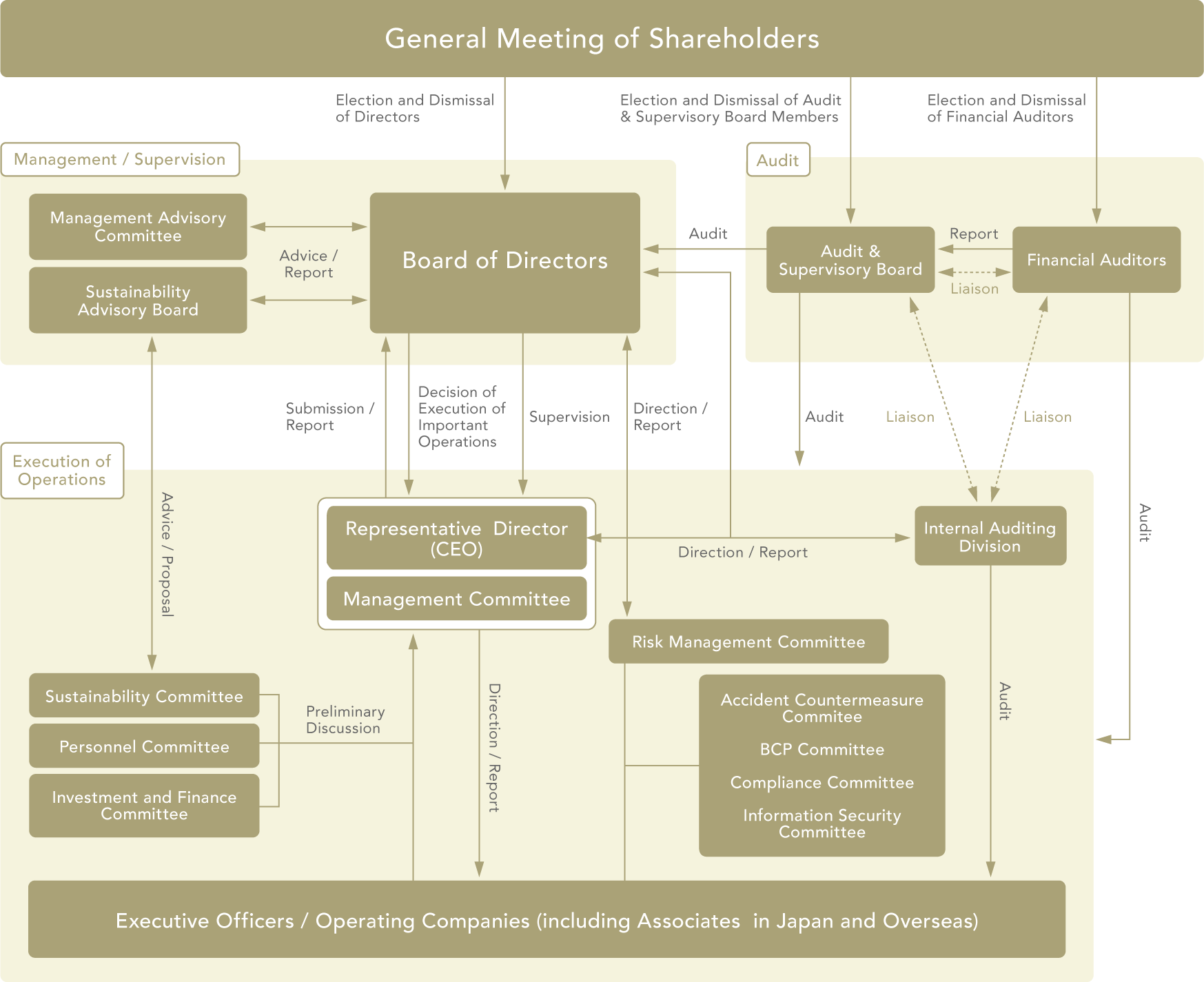

| Organization name | Role | Operating structure |
|---|---|---|
| Sustainability Committee |
|
|
| Working groups |
|
|
Establishment of the Sustainability Advisory Board
The Sustainability Advisory Board is an advisory body to the
Board of Directors established in April 2021 for the purpose
of grasping global trends related to sustainability and
strengthening the internal sustainability promotion structure.
The advisory board discusses environmental, social, and
governance (ESG) issues—such as climate change, human rights,
nutrition, and health—that the NISSIN FOODS Group should
undertake while receiving recommendations from external
experts*1 and offers advice and recommendations to the Board
of Directors*2.
Before meetings of the advisory board, the Sustainability Committee,
which is the operating body, also discusses ESG-related issues
regularly with members who are external experts*3.
- *1Planned to be conducted twice each year
- *2Planned to be conducted at least once each year
- *3Planned to be conducted six times each year
Members of the Sustainability Advisory Board
| Experts (in Japanese name order) |
|
|---|---|
| Internal participants |
|
Initiatives
Meeting of the Sustainability Advisory Board
| Date | Agenda |
|---|---|
| The 1st Meeting (Held on May 31, 2021) |
|
| The 2nd Meeting (Held on December 13, 2021) |
|
| The 3rd Meeting (Held on June 17, 2022) |
|
| The 4th Meeting (Held on January 30, 2023) |
|
| The 5th Meeting (Held on July 4, 2023) |
|
| The 6th Meeting (Held on January 18, 2024) |
|
| The 7th Meeting (Held on July 25, 2024) |
|
| The 8th Meeting (Held on January 16, 2025) |
|
| The 9th Meeting (Held on September 26, 2025) |
|
| The 10th Meeting (Held on February 27, 2026) |
|
- *1A concept that refers to an individual or group being in a good state physically, mentally, and socially
- *2A type of company that has declared its commitment toward taking the lead in businesses that contribute to public benefit in addition to shareholders’ interests
- *3A report published by the EAT-Lancet Commission in 2025. Based on scientific evidence, it presents future projections for food systems and recommended actions related to health, the environment, and justice, with the aim of setting goals to provide healthy and sustainable diets for 10 billion people by 2050
Education and Awareness Activities on Sustainability
The NISSIN FOODS Group fosters employee awareness on sustainability through the dissemination of messages by the chief executive officer (CEO) of NISSIN FOODS HOLDINGS, who is also chairperson of the Sustainability Committee. The Group also informs employees of social and environmental issues, various policies, and Sustainable Development Goals (SDGs), mainly through various training sessions and the Group’s in-house newsletter.
- Training
- The NISSIN FOODS Group conducts training on the theme of sustainability. In addition to holding online seminars on sustainability issues surrounding food and climate change, the Group provides seminar videos as content at its corporate university, NISSIN ACADEMY, thereby supporting employees in voluntarily learning about the latest trends in sustainability and the impacts of the Group’s business on the environment and society.
- Results of Employee Attitude surveys
- Coverage: Employees of NISSIN FOOD PRODUCTS (including
employees on temporary assignment to companies such as
NISSIN FOODS HOLDINGS, NISSIN CHILLED FOODS, and NISSIN
FROZEN FOODS), MYOJO FOODS, NISSIN CISCO, and NISSIN YORK.
Percentage of respondents who answered “Strongly agree” or “Agree”
FY 3/2023 FY 3/2024 FY 3/2025 FY 3/2026 Do you think the company conducts its business in an environmentally responsible manner? 73% 70% 60% 68% Do you think the company contributes to society through its business activities? 87% 86% 76% 86%
Dialogue with Stakeholders
The NISSIN FOODS Group places importance on dialogue with all stakeholders who are involved in the Group’s business activities. Opinions obtained through dialogue are reflected in business activities.
| Target | Communication policy | Key dialogue opportunities |
|---|---|---|
| Customers | Listen to the voices of customers and pursue the creation of even better products. |
|
| Shareholders and investors | Carry out timely and appropriate information dissemination and disclosure, and at the same time, strive to return profits to shareholders and investors. |
|
| Business partners | Strive to build favorable relationships with partner companies by strictly ensuring fair procurement and contracts. |
|
| Employees | Promote the creation of workplaces where all employees feel motivated and enthusiastic and can apply their abilities |
|
| Local and international communities / Governments and public administration | Companies and sites in Japan and overseas seek to collaborate closely with local communities and contribute to the sustainable development of local communities. |
|
| Global environment | Promote activities for Nature Positive* and aim to achieve carbon neutrality—net zero CO2 emissions—by 2050. |
|
- *Intentionally seeking recovery of forests that are being reduced through deforestation and harvesting of forests using means such as raising of forest tree saplings, tree planting, and thinning trees so that sunlight can reach the forest floor.