
Material Issues
Identification of Material Issues
The NISSIN FOODS Group aims for sustainable growth by addressing social issues and creating economic value. To achieve this, we identify material issues that are directly linked to our businesses and which affect the enhancement of the Group’s medium- and long-term corporate value, taking into consideration changes in society and our business environment. In addition, we verify the appropriateness of the identified material issues annually.
In FY 3/2025, we reviewed and analyzed our material issues, referencing the guidance on double materiality assessment published by CSRD/ESRS*. Based on the ESG-related topics stipulated by CSRD/ESRS, we identified both the impacts our business activities have on changes in the environment and society (impact materiality), and the impacts those changes have on our business (financial materiality).
Going forward, we will embody the philosophy of the founder by working on the identified material issues while taking on the challenge of “Planetary Health” and “Human Well-being,” which are social issues for the Group.
- *Corporate Sustainability Reporting Directive/European Sustainability Reporting Standards
- Identification Process
- The NISSIN FOODS Group used the following steps to identify material issues.
Step1: Identification of affected stakeholders
Through discussions at the Sustainability Advisory Board—where members include external experts—and surveys conducted on employees, we identified stakeholders who may be affected by our businesses across our entire value chain.
Step2:Identification of issues and analysis of the issues’ impacts, risks, and opportunities
For the stakeholders identified in Step 1, we analyzed the impacts that our businesses have on ESG issues—such as climate change and sustainable procurement—as well as the accompanying risks and opportunities. For the ESG-related topics, we referenced the topics stipulated by ESRS as well as the requirements of ESG evaluation agencies and other parties, which are of relevance to the NISSIN FOODS Group.
Step3:Evaluation and identification of importance
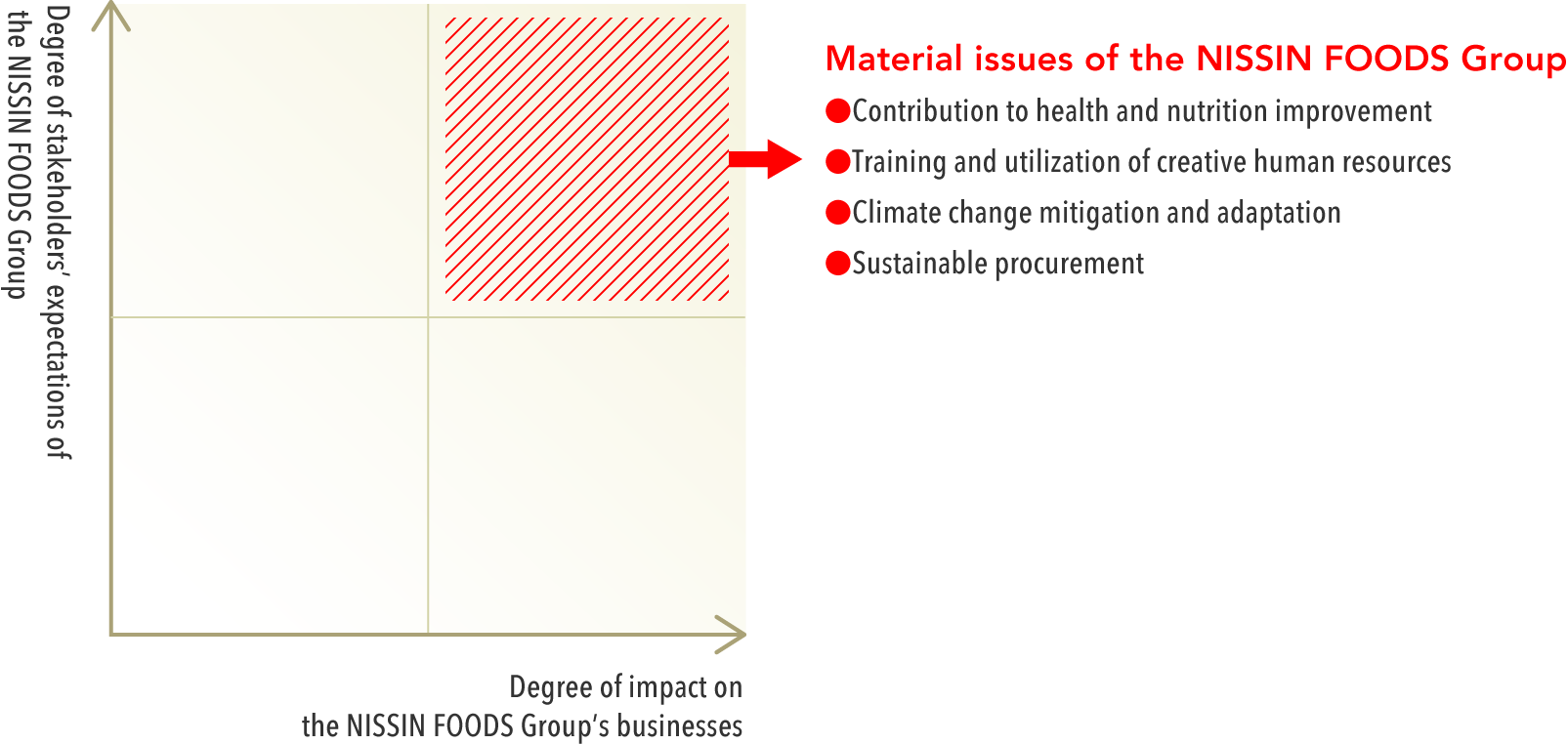
For each ESG issue, we quantified severity and likelihood from
two perspectives—the impacts that changes in the environment
and society have on our businesses (financial materiality) as
well as the impacts of our businesses on changes in the
environment and society (impact materiality)—and formulated
the assessment map.
Based on the assessment map, taking into consideration the Group’s
mission, vision, and values (MVV), overall business structure,
and alignment with our strategies, appropriateness as the Group’s
material issues was confirmed with the top management and the material
issues were decided through resolutions by the Management Committee
and the Board of Directors.
Material Issues in Management Strategies
As important management issues to be undertaken with priority by
the NISSIN FOODS Group, the seven material issues—which are all
extremely important from the perspectives of either financial
materiality or impact materiality—are also linked to the Mid- to
Long-Term Growth Strategy. The Group views material issues not
merely as a risk response, but as an opportunity to strengthen
the foundation of its existing businesses, expand profits
(economic value), and create social value, thereby enabling the
Group to achieve sustainable growth.
“Health and Nutrition” is being undertaken through the rollout of
the KANZEN MESHI (Perfect Meal) brand under the growth strategy theme
of “Pursue New Businesses” stated in the Mid- to Long-Term Growth
Strategy. The implementation of energy-saving measures, introduction
of renewable energy, and procurement of raw materials with consideration
for the environment are being promoted under “Climate Change,” “Biodiversity,”
“Deforestation,” and “Sustainable Value Chain Management” while also
linking these issues to the targets stated in the environmental strategy
EARTH FOOD CHALLENGE 2030. For “Human Resource Development,” human
resources are seen as the foundation for implementing the Mid- to
Long-Term Growth Strategy, and various measures—such as the Group
philosophy training—are being undertaken to invigorate employees
and organizations.
In addition, from FY 3/2026, the degree of achievement of targets
related to the material issues—such as climate change and sustainable
procurement—is also reflected in the performance evaluation for officer
remuneration, including that for directors.*
- *The performance-linked basic remuneration for directors fluctuates from 0 to 50%, while that for executive officers fluctuates within a maximum range of 40%, from -20% to +20%. The weight of the evaluation of ESG-related objectives differs for each officer.
Impacts, Risks, Opportunities, and Targets
The NISSIN FOODS Group analyzed the impacts of the Group’s material issues as well as the accompanying risks and opportunities to enhance its medium- and long-term corporate value. For those materials issues considered extremely important from both the perspective of “financial materiality” or “impact materiality” we have set the following targets and are working to achieve them.
1. Health and Nutrition / Product Safety
| Item | Summary | Severity | Likelihood | Overall assessment |
|---|---|---|---|---|
| Key risks |
| High | High | Extremely Important |
| Key opportunities |
| |||
| Targets |
| |||
| Progress / Related initiatives | Health and Nutrition | |||
2. Human Resource Development
| Item | Summary | Severity | Likelihood | Overall assessment |
|---|---|---|---|---|
| Key risks |
| High | High | Extremely Important |
| Key opportunities |
| |||
| Targets |
| |||
| Progress / Related initiatives | Human Resource Development Human Capital Report [PDF 5.7MB] | |||
3. Climate Change
| Item | Summary | Severity | Likelihood | Overall assessment |
|---|---|---|---|---|
| Key risks |
| High | High | Extremely Important |
| Key opportunities |
| |||
| Targets |
| |||
| Progress / Related initiatives | Climate Change EARTH FOOD CHALLENGE 2030 | |||
4. Biodiversity / Deforestation / Sustainable Value Chain Management
| Item | Summary | Severity | Likelihood | Overall assessment |
|---|---|---|---|---|
| Key risks |
| High | High | Extremely Important |
| Key opportunities |
| |||
| Targets |
| |||
| Progress / Related initiatives | Sustainable Procurement | |||
Integration of Material Issues into Group-Wide Risk Management
As sustainability-related risks—such as the material issues—have an impact on the achievement of the Group’s growth strategy, they are managed as Group-wide risks in collaboration with the Comprehensive Risk Management Committee, which is chaired by the Executive Vice President & Representative Director and Chief Operating Officer (COO).